
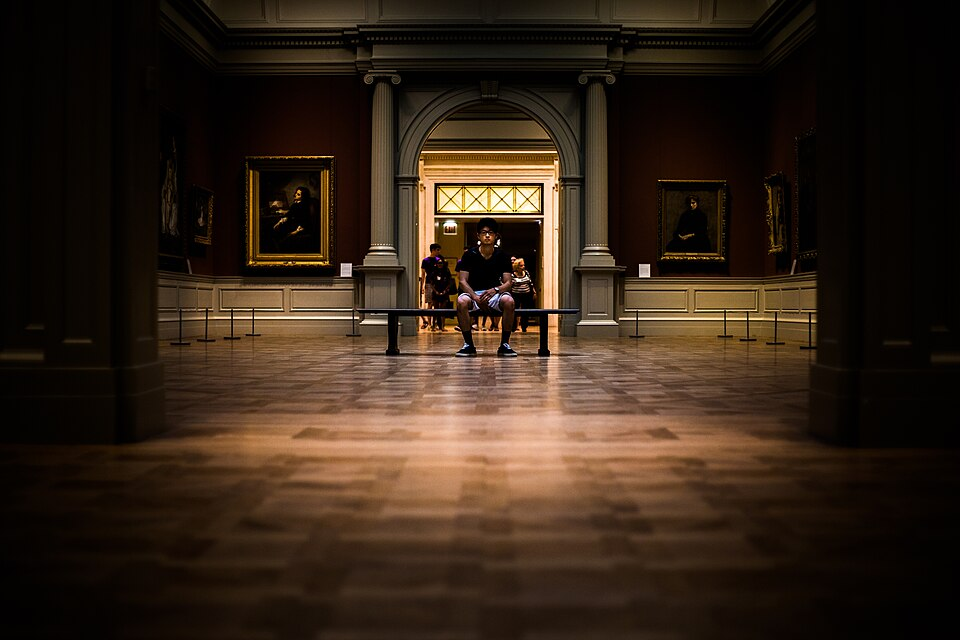
A painting viewed alone on a web page tells a different story from a painting placed within a room. For readers trying headset media, Brain Dance VR provides a general playback reference. A museum experience still needs to be assessed on its own terms: what was captured, how the visitor can move and which information the digital presentation preserves.
The room matters because it gives the artwork neighbours, a viewing distance and a place within a sequence. Even a doorway can change the order in which a visitor notices things. A virtual presentation can make those relationships available to someone far away, while also introducing decisions that differ from the physical visit. Understanding those decisions makes the experience more interesting to examine.
Look at the room before the individual work
Begin by inspecting the overall arrangement. Which objects face each other? Is there a clear route between sections? Does a large work dominate a wall, or is it part of a dense grouping? These relationships may be difficult to infer from isolated photographs on a collection page.
A panoramic view can preserve a sense of that arrangement from a particular camera position. An interactive reconstruction may permit more movement, depending on how it was built. Check the available controls before assuming you can approach every corner. A missing viewpoint is a limit of the digital presentation, not necessarily a feature of the gallery itself.
Distinguish the captured room from its interpretation
A digital exhibition can reproduce an existing space or invent a new one. It may rearrange objects, add explanatory material or present works that are physically held in different locations. Those choices can serve a thoughtful curatorial purpose, but the visitor should know which kind of experience is being offered.
Read the introduction and object labels for that context. Look for an explanation of whether the scene is a photograph, a reconstruction or a purpose-built exhibition. If dimensions and colours are important to your interest in the work, check the collection’s accompanying records. The feeling of standing near an object does not by itself establish measurement or colour accuracy.
Use distance as a way to ask questions
In a gallery, stepping back can reveal the relationship between a work and its surroundings. Moving closer can draw attention to a detail. A virtual experience may support both actions, only one of them or a limited set of viewing positions. Explore what is actually available without confusing a zoomed image with a newly captured angle.
Try comparing the whole composition with a detail view when the collection provides one. Ask what each presentation makes easier to notice. The wider room may clarify placement and scale, while a separate high-resolution image may reveal marks or materials that the immersive view cannot resolve. These formats can complement one another.
Let labels remain part of the visit
An immersive room can encourage visual exploration, but information about the work remains essential. Check whether labels are readable and whether you can return to them after looking away. If audio narration is offered, find the controls and any available transcript or captions before beginning a long sequence.
Keep your own notes separate from the museum’s claims. An impression about mood or spatial relationships is a personal response. A statement about an artist, a date or an object’s history should come from the collection’s documentation. This distinction allows a visit to be both imaginative and careful about what is known.
Make room for a second look
A useful advantage of a digital visit is the possibility of revisiting an arrangement without repeating a journey. Return to one room after reading about a work and see whether the surrounding objects now suggest a different connection. Follow the experience’s available navigation rather than feeling obliged to complete every section in one sitting.
The most rewarding virtual museum visit need not reproduce every sensation of a physical gallery. It can offer a particular way to examine placement, sequence and attention. Notice which relationships the room makes visible, and which details require another source. That approach treats the digital space as a considered presentation of art, with choices that are worth looking at as closely as the objects themselves.